Why Enterprises Are Starting to Need an AI Gateway
Why Enterprises Are Starting to Need an AI Gateway
From "Calling an LLM API" to "Managing an Enterprise AI Model Portfolio"
Over the past two years, large language models (LLMs) have rapidly moved into enterprise applications. From customer support and knowledge-base Q&A to coding assistants, data analysis, and AI agents, more and more companies are wiring GPT, Claude, Qwen, and DeepSeek into their business systems.
But as AI usage deepens inside the enterprise, a key shift is happening:
Models are no longer just "external APIs" — they're becoming one of the company's core assets.
Inside many enterprises, the shape of "a model" has already become quite varied:
- APIs from OpenAI, Anthropic, or domestic model vendors;
- Self-hosted open-source models (DeepSeek, Qwen, GLM, etc.);
- In-house models fine-tuned on proprietary data;
- Embedding models (for vector retrieval);
- Reranker models (for ranking optimization);
- Text-to-image / text-to-video models (multimodal generation);
- Even collections of fine-tuned model variants each business line maintains on its own.
In other words, enterprise AI is evolving from "a single API call" into:
A multi-model, multi-source, multi-form model asset system
In the early stage, plugging an LLM into a company was simple:
Business system → LLM API
A developer requests an API key and calls the model directly from application code.
But as the number and variety of models grows, things get complicated fast:
- How should employee API keys be managed — scattered across code, or issued and rotated centrally at the gateway layer?
- How is model spend tracked — by team, by application, or by user, for cost attribution?
- Which requests are allowed to go to the public cloud (GPT, Claude), and which must stay on private infrastructure (sensitive data, internal knowledge)?
- Which model APIs should the company even buy — run several models in parallel, or standardize on a few primary models plus fallback?
- When a model upgrades (say GPT-4 → GPT-4.1), how do existing call sites migrate smoothly? Do you need canary rollout, A/B testing, or a compatibility layer?
- When a provider rate-limits you or a region goes down, how do you keep the business running — do you need automatic failover to a backup model?
- How do you avoid vendor lock-in, so model capability can be swapped out at any time without disrupting the business?
Enterprises eventually realize:
The problem is no longer "how do I call an API" — it's "how do I manage an entire model landscape."
That's the root reason AI Gateways exist.
What Is an AI Gateway?
An AI Gateway is a unified management and dispatch layer sitting between an enterprise's AI applications and every model service it uses.
"Every model service" here isn't just:
- External APIs like OpenAI, Claude, Gemini
- It also includes self-hosted private models
- As well as specialized services like Embedding, Reranker, and text-to-image / text-to-video
Traditional architecture:

With an AI Gateway in place:
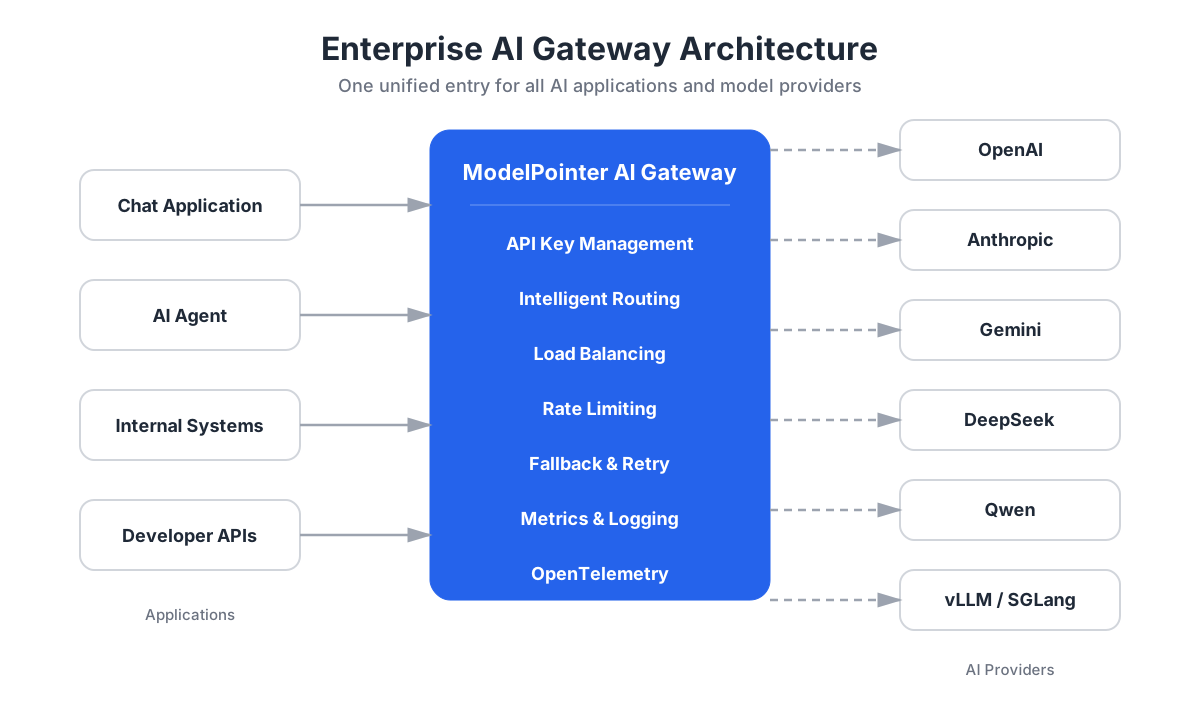
The core job of an AI Gateway is to:
Turn scattered model capabilities into managed model infrastructure.
It's similar to a traditional API Gateway in internet architecture, except what it manages has been upgraded from "API requests" to:
Model calls + model routing + model governance + model asset management
Why Do Enterprises Need an AI Gateway?
1. Unified management of multi-type model assets
The "models" inside an enterprise are usually not a single thing — they're a portfolio that accumulates over time: external APIs, self-hosted models, in-house fine-tuned models, Embedding, Reranker... each one typically introduced at a different time, by a different team.
Without unified management, this is what it looks like:
Support system   → GPT API (key held by the support team)

Knowledge base    → Qwen API + Embedding (key held by the data team)

Dev assistant     → Claude API (key held by the engineering team)

Data analytics    → DeepSeek API (key held by the analytics team)
No one can answer: how many models does the company actually have integrated? Who's using each one right now? If we switch vendors, how many places does the code need to change?
An AI Gateway isn't just a single call entry point — it's a model asset registry: each model is registered once at the gateway — type, capability, price, latency, owning team — and business systems only ever reference the model by name, with no need to know which vendor or which API key sits behind it. Adding a model is just adding a registry entry; replacing or retiring one only means changing the gateway config, not touching every downstream system's code.
A model is a registered, tracked asset — not a call detail scattered across your codebase
This becomes even clearer during model upgrades. Application code never actually calls a specific model version — it calls an alias, something like production-chat-model; the gateway points that alias at whichever model is currently live. When a model upgrades (say GPT-4 → GPT-4.1), you just repoint the alias to the new version — existing calls automatically flow to the new model. No hunting through the codebase for hardcoded model names, and no waiting for every downstream system to update and redeploy before the switch actually takes effect.
2. Turning "model cost" into a governable resource
In the AI era, the core cost driver is no longer servers — it's:
Tokens + inference calls + the complexity of the model call chain
Once usage scales, enterprises have to answer: which team is burning the most tokens? Which agent is the most expensive? Which requests could actually be served by a cheaper model? Is Embedding / Reranker being over-called?
Answering those questions first requires being able to "see" every call — an AI Gateway centrally logs request counts, input/output tokens, the full model call chain (LLM + Embedding + Reranker), latency and success rate, and attributes cost by application / team / user.
With that data in hand, routing can adjust dynamically for cost:
Simple tasks         → small / low-cost models
Complex tasks         → GPT / Claude and other high-capability models
Retrieval workloads    → Embedding → vector search → Reranker → LLM
Cost goes from an untraceable bill to a visible, optimizable routing decision
3. Unified management of private and external models
A key shift in enterprise AI architecture:
A model no longer lives in just one place
For the same model, many enterprises keep both a private deployment and a public cloud API as two backends — private deployment is cheaper and keeps data inside the network, but has limited capacity; the public cloud scales elastically, but costs more per unit. Ideally, traffic goes to the private deployment first, overflowing to the public cloud only when capacity runs out. An AI Gateway supports primary/fallback tiered routing: requests hit the private deployment first, and once rate limits trigger, traffic automatically shifts to the public cloud API as a fallback. From the application's point of view, it's always calling the same model name — it never perceives the traffic moving between private and public cloud.
That's just the question of where a model is deployed. Go one level further, and enterprises typically also need to integrate more than one vendor at the same time — not because of protocol incompatibility (mainstream model providers are now largely OpenAI-compatible, so integration itself isn't hard). The real reason is that models iterate too fast: whichever model is best this month might get overtaken by a competitor in three months — no single vendor stays ahead across the board forever. To keep using state-of-the-art models, a company has to connect to several vendors at once:
- External APIs: the latest GPT, Claude, Qwen... whichever is ahead
- Private open-source models: vLLM / SGLang running on local GPU clusters
- In-house models: fine-tuned on proprietary business data
- Specialized models: Embedding, Reranker
If onboarding every new vendor, or switching your primary model, means rewriting call logic and shipping a release across every business system, then "switch to whatever model is best right now" gets throttled by integration cost, and the company ends up settling for whatever's already wired in. An AI Gateway collapses that integration cost down to one place: a new model only needs to be registered once at the gateway, application code doesn't change, and switching just means repointing an alias at the new model.
Which vendor a model comes from, and where it's deployed, shouldn't be something application code has to care about
4. Improving the stability and availability of model services
A business can't depend on a single model or a single vendor.
In practice, model services can run into:
- API rate limiting
- Regional network unavailability
- GPU service outages
- Incompatible model version upgrades
- Insufficient private model capacity
An AI Gateway can provide:
Automatic degradation and multi-model disaster recovery
Specifically, rate limiting and routing are both designed in layers: a request first passes through rate limiting — there's a limit on the model as a whole, and a separate limit for each API key under that model; only once both pass does the request actually get routed. The routing target itself is split into primary and fallback tiers: within a tier, if a backend becomes unhealthy, a circuit breaker pulls it out of rotation and traffic stays on the healthy backends in that same tier; only when the entire primary tier runs out of capacity (rate limited) does traffic fall back to the secondary tier.
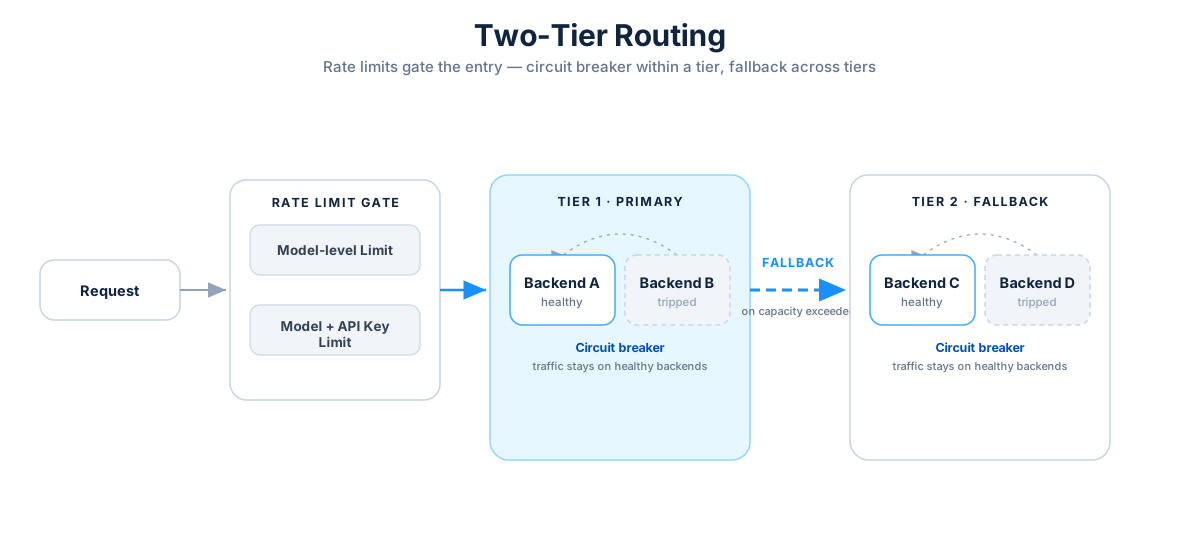
Embedding / Reranker can be configured the same way, with multi-version fallback and local caching — business systems stay unaware of the complexity underneath.
5. Enterprise-grade permissions, security, and model governance
Once models become a core enterprise asset, governance questions follow: how should employee API keys be issued, rotated, and revoked? Which data is allowed to go to external APIs, and which models are internal-only? What's each team's token ceiling, and are they even allowed to use high-cost models?
An AI Gateway turns these into configurable policy instead of relying on tribal knowledge:
- Unified API key / token management
- Permission isolation by team / application / agent
- Model-level access control (LLM / Embedding / Reranker)
- Data residency / export controls
- Full audit logging (every model call chain is traceable)
AI usage moves from "developers calling whatever model they want" to "an enterprise-governable model asset system."
Will the AI Gateway Become Enterprise AI Infrastructure?
The pattern looks a lot like earlier technology shifts:
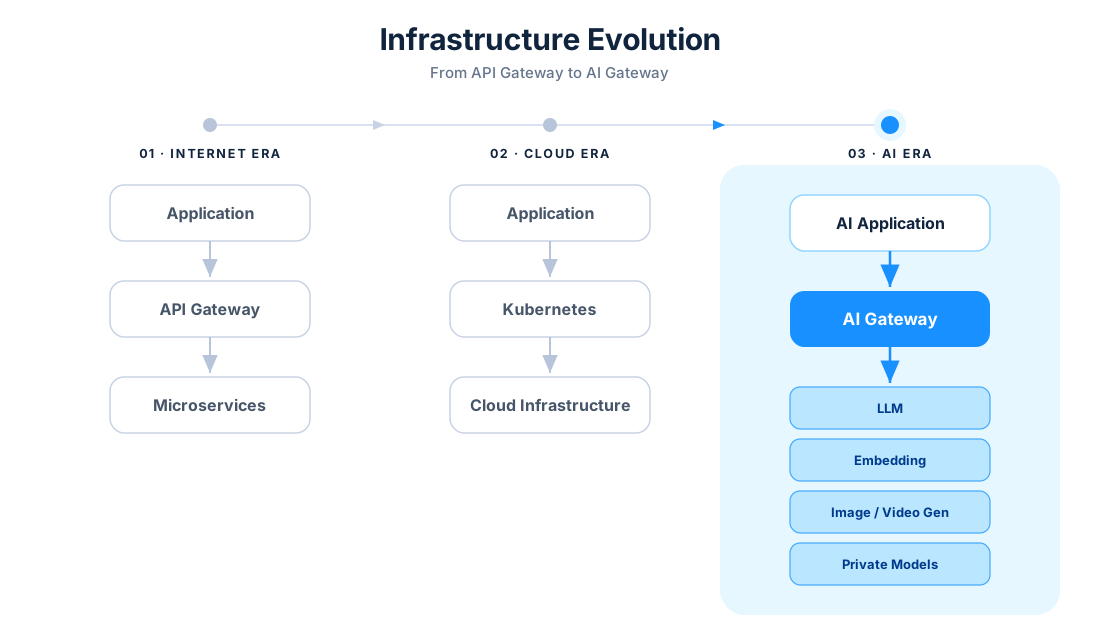
As enterprise AI usage scales up, the number of models, the variety of model types, and the number of sources all keep growing, and the call chain keeps getting more complex.
The AI Gateway is moving from "optional component" to:
The core control plane of AI infrastructure
ModelPointer: An AI Gateway Built for the Enterprise
For enterprises dealing with multiple models, multiple sources, and multiple teams, ModelPointer provides an enterprise-grade AI Gateway.
ModelPointer supports:
- OpenAI / Anthropic protocol compatibility: /v1/chat/completions, /v1/messages, /v1/embeddings, /v1/responses
- API key management: issue independent keys per downstream consumer, with per-key rate limits to precisely control each consumer's capacity
- Rate limiting: sliding-window limits (RPM / TPM) by key + model or by model alone, backed by in-process state or Redis
- Weighted routing: smooth weighted round-robin (SWRR) and consistent-hashing strategies
- Primary / fallback tiered routing: when the primary tier exceeds its capacity threshold, traffic automatically shifts to the fallback backend instead of returning a 429 to the client
- Circuit breaking: automatically marks unhealthy upstreams and restores them once they recover
- Protocol-level independence: OpenAI and Anthropic configurations for the same model are fully independent, each with its own backends, policies, and capacity
- Two configuration modes: YAML files with hot reload, or database-backed config (SQLite / PostgreSQL / MySQL) with periodic polling
- TLS termination: optional TLS configuration backed by a PEM certificate and private key
- Observability: structured JSON access logs, Prometheus metrics, and OpenTelemetry tracing
With ModelPointer, enterprises can:
Turn scattered model capabilities into manageable, observable, optimizable AI infrastructure
...letting developers focus on building AI applications instead of wrestling with model integration and governance.
Website: https://modelpointer.com · GitHub: https://github.com/modelpointer/modelpointer
Conclusion
Large models are turning from a "tool" into an "asset."
And once an enterprise holds external LLM APIs, private models, fine-tuned models, Embedding / Reranker, and text-to-image / text-to-video models all at once, the complexity of AI stops being a "how do I call it" problem and becomes an "asset management" problem.
At its core, an AI Gateway is about:
Letting enterprises manage model assets the way they already manage cloud resources
In the AI era, this layer of infrastructure is becoming indispensable.