Why Enterprises Can't Say Where Their Monthly LLM Bill Went
Why Enterprises Can't Say Where Their Monthly LLM Bill Went
This is the fourth post in the AI Gateway series.
A Bill Nobody Can Explain
Early in the month, finance drops last month's LLM bill in the group chat: a six-figure number. Someone asks the obvious question — where did most of this go? — and the chat usually goes quiet. The customer support team can account for their slice, the knowledge base team can account for theirs, but nobody can add it all up and break it down into who spent what, on which model, and whether it was worth it.
This isn't an isolated case. Once enterprise LLM usage reaches scale, "we can't explain the bill" is close to inevitable. It's rarely a budget problem or a lack of ownership — it's that call records were never centralized in one place to begin with.
Why the Bill Never Adds Up
1. Call records scatter across each business system's own logs
Even when every business system already pulls its key from a shared gateway, if the gateway itself doesn't meter anything, "who called what" still only lives in each system's own application logs — different formats, different granularity. Some log only success/failure; some don't record token counts at all. The bill isn't unexplainable because there's no gateway — it's unexplainable because nothing records every call in one consistent place.
2. Call count isn't cost — tokens are the actual unit of pricing
Pricing can differ by tens of times across models, and input and output tokens on the same model are usually priced differently too (output is often several times more expensive). If the metric you track is just "number of calls," a short Q&A and a long document summary land in the ledger as the same "one call," even though the real cost can differ by two orders of magnitude. Without breaking usage down by model and by input/output tokens, "usage" and "cost" are two different numbers.
3. One user request can trigger several model calls behind the scenes
A single knowledge-base query is often really Embedding → vector search → Reranker → LLM chained together. If those calls happen across different services or modules, nobody can stitch them back into one chain and answer "what did this one question actually cost" — all the ledger shows is a handful of unrelated line items.
4. A total with no dimensions is a number nobody owns
Even if the gateway or the provider's dashboard shows total tokens and total spend for the month, if that number can't be broken down by team, application, or environment, it's just an isolated total — it can't answer who's responsible for it, and it rules out any real cross-team cost allocation.
The Root Cause: No Shared Place Where Call Records Land
All of the above comes down to the same thing: the job of recording each model call was left to every business system on its own, instead of living in the one place every call is guaranteed to pass through.
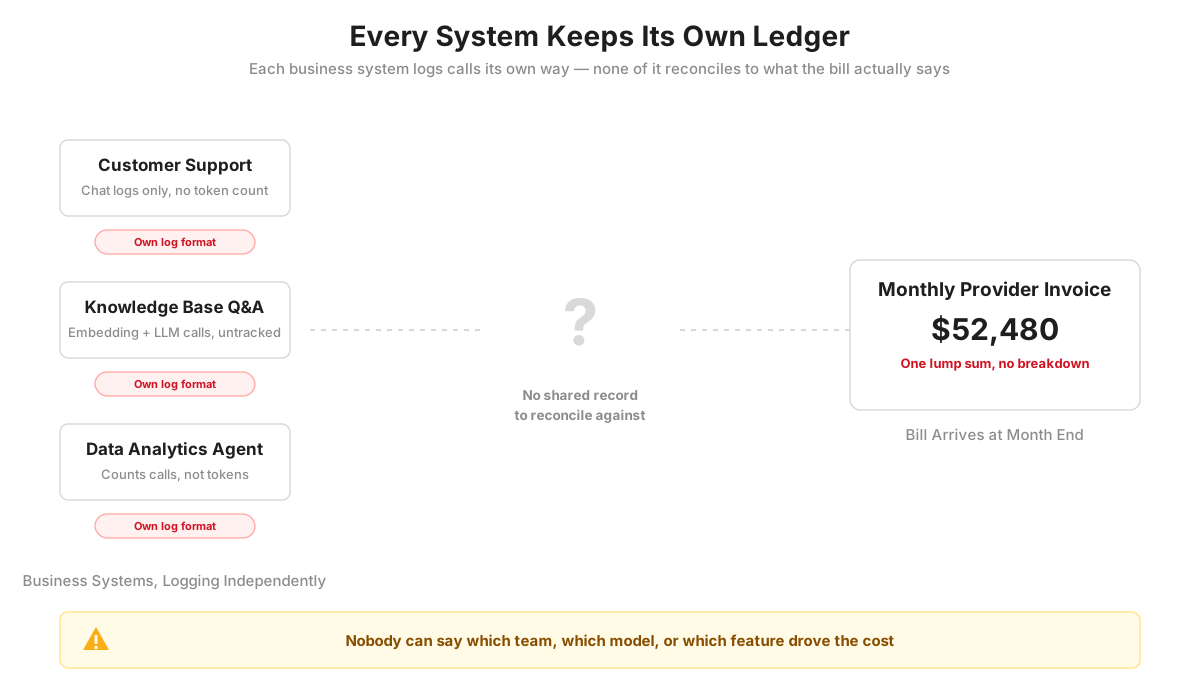
The result: dozens of inconsistently formatted application logs on one side, and a single lump-sum invoice from the provider on the other — with nothing in between to connect them.
The Better Approach: Meter Once, at the Gateway, and Let the Ledger Build Itself
The gateway is already the one place every model call passes through — whether it's customer support or a data analytics agent, the request ends up routed through the gateway to whatever backend serves it. That means recording the key facts about each call right there, at the gateway, means no business system needs to instrument its own metrics or maintain its own accounting convention — a single, reconciled ledger builds itself.
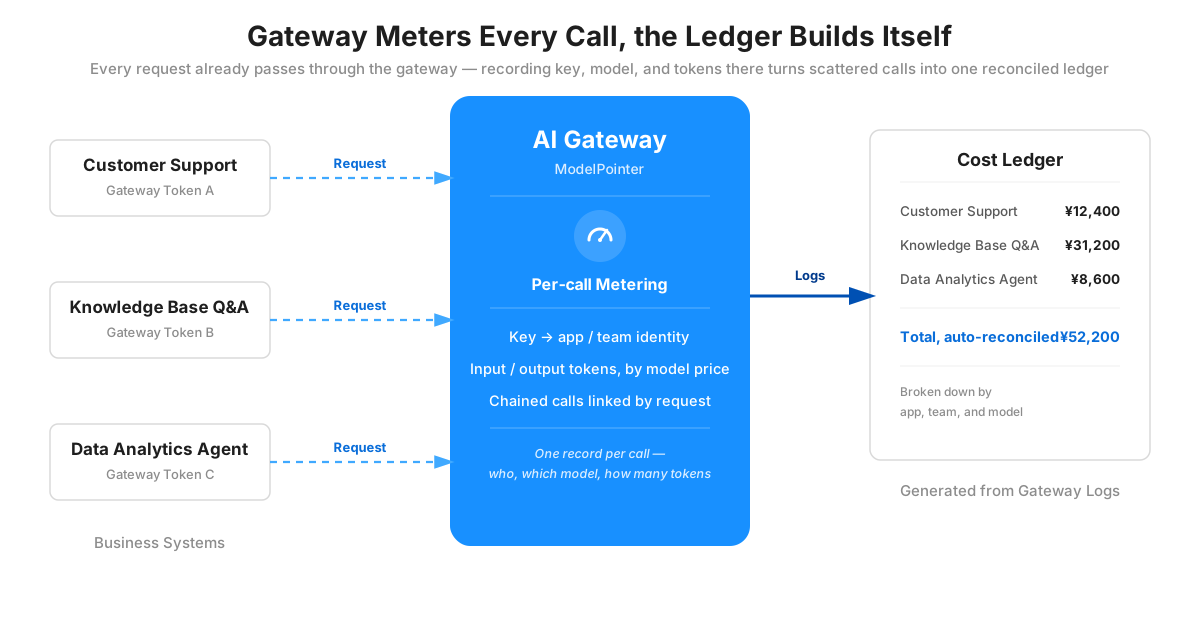
Concretely, this layer needs to do at least the following:
- Every key already carries an identity: each business system holds a key the gateway issued specifically for it, so a call record tagged with that key already knows which business made the call — no extra instrumentation in application code required;
- Break out input vs. output tokens and convert to real cost by model price: not a generic "call count" — different models and different token types get priced consistently at the gateway layer;
- Chain multi-step calls by request: if one Q&A triggers Embedding, Reranker, and LLM calls, the gateway can link them into one chain and show what a single real business request actually cost, instead of a handful of disconnected line items;
- Alert on anomalies as they happen: if a key or application's burn rate suddenly drifts from its historical baseline, that can trigger an alert in the moment, instead of surfacing only when the month-end invoice arrives;
- Export the data directly: structured logs and standard metrics formats plug straight into an enterprise's existing BI or reporting stack — no separate accounting convention to build, and no manual monthly reconciliation.
The ledger stops being a total you passively receive at month end, and becomes a line item that's already written the moment the call happens
How ModelPointer Solves This
In ModelPointer's design, metering and forwarding are two sides of the same layer — everything worth recording gets recorded as the request passes through:
- Independent API key issuance: each downstream business system gets its own key, so every call record already carries the identity of who made it — no extra instrumentation needed;
- Full access logging: structured JSON access logs record the key, model, input/output tokens, latency, and success rate for every call, ready to aggregate directly by application or team;
- Prometheus metrics and OpenTelemetry tracing: see how many tokens each team burned in the last hour, and use tracing to see the full Embedding → Reranker → LLM chain behind a single request;
- Protocol-independent metering: OpenAI and Anthropic protocol calls are metered independently, so nothing gets dropped or conflated because of a protocol difference;
- Two configuration modes: whether it's hot-reloaded YAML or database-backed config, adjusting rate limits or routing policy never requires redeploying a business system, and never interrupts metering data already in flight.
Conclusion
An unexplainable LLM bill looks like a reporting problem on the surface. In practice, it's that nothing has recorded each call in one shared place from the moment it happened.
Whether you can explain where an AI bill went has nothing to do with how polished the report looks — it depends on whether the call was recorded the moment it happened
Centralize metering at the gateway layer, and business systems don't need to write another line of instrumentation just to account for cost — the ledger builds itself, one call at a time.
Website: https://modelpointer.com · GitHub: https://github.com/modelpointer/modelpointer
About This Series
This is the fourth post in the "AI Gateway and Enterprise AI Infrastructure" series. The first three posts covered why this layer of infrastructure is emerging, why API keys shouldn't be handed directly to business systems, and why cloud models are still needed after self-hosting:
👉 Why Enterprises Are Starting to Need an AI Gateway 👉 Why Enterprises Shouldn't Hand LLM API Keys Directly to Business Systems 👉 Why Enterprises Still Need Cloud Models After Deploying LLMs On-Prem
More posts in this series are on the way — covering complexity-aware model routing and on-prem vs. cloud cost comparisons in practice.